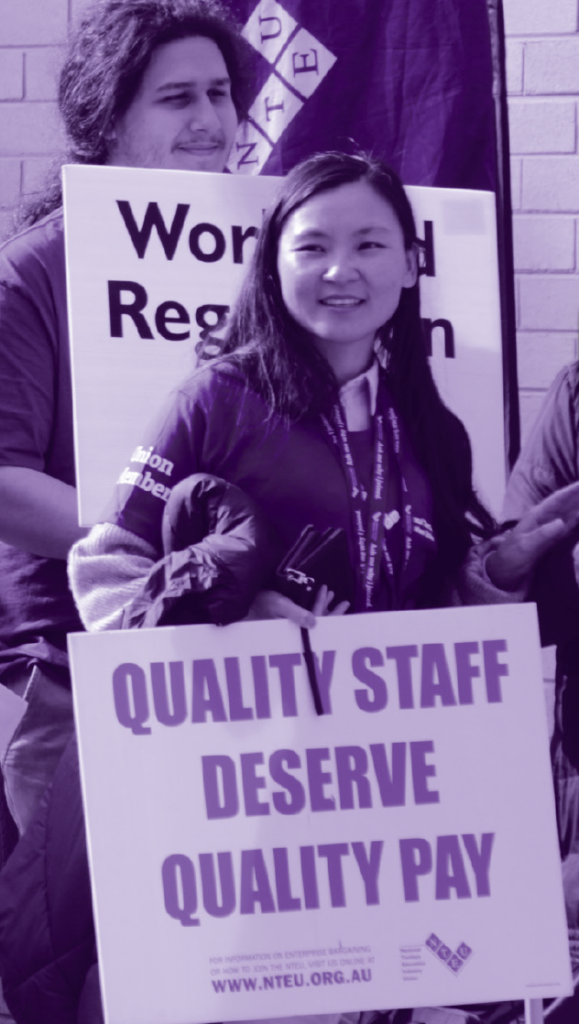
Professional and general staff deserve safe, secure, respectful workplaces where their time, expertise, wellbeing, and voices are genuinely valued.
The claims:
Right to
disconnect
Job security protections
Workload
Protections
Intellectual
Freedom
Redeployment
entitlements
Flexible work
arrangements
Right to disconnect
Many of you have told us the pressure to stay constantly connected, checking emails late at night, answering calls on weekends, and working through holidays, is taking a serious toll on your health and your lives.
A right to disconnect gives you a clear and enforceable boundary between work and personal time. It protects health, wellbeing, and family life, and helps prevent burnout. This is not just about switching off; it is about creating a culture of respect, work/life balance, and sustainability.
Embedding this right in enterprise agreements helps build healthier, more productive workplaces for everyone.
FAQs
Isn’t this already a right we have under the Act/NES?
The National Employment Standards provide only a basic standard. Our claim makes the right to disconnect relevant to our sector and meaningful by embedding it in your enterprise agreement.
Our manager says we need to be contactable, for flexibility and emergencies
If after-hours contact is genuinely necessary, it should be reasonable, clearly defined, and either agreed upon in advance or appropriately compensated.
Emergencies are very rare, and this right ensures you’re not expected to be constantly available without limits.
Job security protections
Professional and General staff are being battered by endless restructures, often forced to reapply for their own jobs in cruel “spill and fill” exercises.
Across universities, staff are regularly subjected to what many call “death by restructuring,” creating chaos, dysfunction, and deep uncertainty. These restructures are rarely about improving service delivery.
More often, they’re driven by cost-cutting or targeting staff who managers don’t like, or refuse to work unreasonable hours, not by genuine operational need. This results in job cuts, workload intensification and under-resourcing
Constant restructuring is a distraction from core university business. It damages staff wellbeing, undermines working conditions, disrupts the student learning experience, and wastes university resources.
This doesn’t mean universities should never review their operations. But NTEU members are deeply concerned about the frequency, poor planning, and harmful impacts of these changes.
Our claim seeks to limit arbitrary management decisions, prevent change for change’s sake, and protect our colleagues from needless job loss.
FAQs
The uncertainty surrounding the sector because of future decline in government funding, and caps on international students mean that universities need flexibility to make changes.
Many Universities are overplaying the structural uncertainty in the sector to justify the changes they may want but are rarely necessary.
Restructuring rarely solves underlying financial issues. What they do is cut experienced staff, damage morale, and harm service delivery. Long-term stability comes from investment in staff, not endless change.
The university will be forced to use more insecure workers to have flexibility to cut jobs.
This clause will work in conjunction with other clauses aimed at reducing casualisation. But we believe that if our managers stop implementing constant, poorly thought-through and disruptive changes, and instead properly consult staff about how best to organise our work, it will save us money and show them the value of experienced, long-term staff in secure jobs. This claim will ensure that when change occurs, it is well considered, meets the operational requirements of the university, and results in genuine improvements.
Enforceable Workload Protections and Review Procedures
Unreasonable and unsafe workloads are undermining the wellbeing and capacity of professional staff across the university sector.
These claims aim to build fairness, equity, and transparency into workload allocation, making work safer and more sustainable. Management’s unrealistic expectations are putting staff health at risk and contributing to burnout.
Nearly one-third of professional and general staff are working extra hours without pay or time off in lieu. Many redundancies and ‘voluntary’ departures are being absorbed by remaining staff, who are left to carry the increased workload.
FAQs
The uncertainty surrounding the sector because of future decline in government funding, and caps on international students mean that universities need flexibility to make changes.
Many Universities are overplaying the structural uncertainty in the sector to justify the changes they may want but are rarely necessary.
Restructuring rarely solves underlying financial issues. What they do is cut experienced staff, damage morale, and harm service delivery. Long-term stability comes from investment in staff, not endless change.
The university will be forced to use more insecure workers to have flexibility to cut jobs.
This clause will work in conjunction with other clauses aimed at reducing casualisation. But we believe that if our managers stop implementing constant, poorly thought-through and disruptive changes, and instead properly consult staff about how best to organise our work, it will save us money and show them the value of experienced, long-term staff in secure jobs. This claim will ensure that when change occurs, it is well considered, meets the operational requirements of the university, and results in genuine improvements.
Protection of Intellectual Freedom/Freedom of Expression for Professional and General staff
Intellectual freedom is at the heart of what defines a university. It’s not just about academic research, it’s about fostering a culture where ideas can be debated, policies can be questioned, and truth can be pursued without fear of reprisal.
This claim seeks to embed real, enforceable protections for intellectual freedom and freedom of expression into our industrial agreements for professional and general staff, alongside Academic staff.
Professional and General staff are integral to the intellectual, ethical, and operational life of the university. They support research, teaching, governance, and public engagement. Their insights and expertise are critical to the integrity and accountability of the institution.
All staff should be able to do their job without fear of retaliation. No one should face pressure, interference, or punishment for raising concerns, offering expert opinions, or participating in public debate in good faith.
FAQs
Academic/intellectual freedom can be protected through the Code of Conduct. It needs to be tempered with the responsibilities staff have under the Code.
The Code of Conduct and policies are not enforceable in the same way as the enterprise agreement. While staff may be consulted on policies, these documents are ultimately controlled by management and can be changed without collective agreement. Referencing them in the Agreement undermines enforceable protections and leaves staff vulnerable to managerial discretion.
Job security and intellectual freedom should not depend on the selective application of an unenforceable code. The enterprise agreement must set clear, binding rules for management, not defer to policies that sit outside the Agreement.
Intellectual freedom is essential to the mission of universities. It requires the protection of views that may be unpopular or controversial, and the freedom to question accepted norms. This standard goes beyond what is typically allowed under codes of conduct, which are often vague, inconsistently applied, and subject to change without staff input.
Academic freedom is for academics. Professional staff don’t need those protections
Intellectual freedom means the freedom to pursue knowledge without fear or favour. This is central to the mission of the university. However, this isn’t limited to academic roles; it’s essential to the integrity and functioning of the university.
Professional and general staff make critical contributions to governance, policy, compliance, research administration, student services, and public communication. Their expertise and judgment directly shape how the university fulfils its academic mission. Without protection, these staff can be silenced or disciplined for raising legitimate concerns about management decisions, ethical breaches, or institutional transparency.
Improved and enforceable entitlements to Redeployment for Professional and General staff
Universities say they value their staff, but too often people are pushed out when their role changes instead of being given a fair chance to stay. This claim fixes that. It makes redeployment real with early intervention, priority matching new jobs, training opportunities, and proper case management.
It’s not just good for staff; it’s good for the university. Keeping skilled, experienced people saves money, maintains service quality, and shows genuine commitment to fairness.
FAQs
Redeployment is already part of our redundancy process
Existing redeployment provisions are insufficient to ensure meaningful outcomes. This claim establishes a structured process incorporating appropriate support, training, and skills-matching measures to facilitate genuine redeployment, not just a box-ticking exercise where staff are sent jobs to apply for.
Not every displaced staff member can be redeployed
True, but every staff member should have access to a fair, transparent process and support to find alternative work or retrain. This claim ensures dignity and fairness, even when redeployment isn’t possible.
Access to Flexible work arrangements
We’ve all seen how flexible and remote work can make our lives more manageable. Remote work can save us 1-2 hours a day of wasted commuting. It lets us get a few household chores down during break time, freeing up our evenings and weekends for relaxation and leisure and improving our work/life balance. This should be the new normal.
Flexible work arrangements with clear and transparent processes for approval and review belong in enterprise agreements. They ensure that staff with certain attributes can balance their work with other aspects of their lives.
FAQs
We’re more productive in the office/ You can’t replace face-to-face
Many staff have found they can be more productive at home, particularly for certain kinds of tasks.
The claim doesn’t seek to replace face-to- face, but to allow more flexibility for work to be completed from home where possible and appropriate. COVID has shown us that much of the work previously considered ‘impossible’ to do from home can, in fact, be done from home.
Flexible work arrangements are already covered in the Fair Work Act
Flexible work arrangements belong in university agreements. Such rights fundamentally guarantee that staff with certain attributes can balance their work with other aspects of their lives. This diversity is core to [whichever universities] values and the Agreement should match that rhetoric.
SEE ALL THE PRIORITIES →

Fair Pay. Better Universities.

Secure Jobs. Better Universities.